
The BRICS nations on Friday underlined the need for using local currencies in international trade and financial transactions besides committing themselves to supporting rule-based open and transparent global trade. A joint statement issued at the end of the meeting of the BRICS Ministers of Foreign Affairs and International Relations, also pressed for a robust Global Financial Safety Net with a quota-based and adequately resourced International Monetary Fund (IMF) at its centre. It further said the process of IMF governance reform under the 16th General Review of Quotas, including a new quota formula as a guide, should be completed by December 15, 2023.

Except for Westlife Foodworld (Westlife), a weak 2022-23 (FY23) January-March (fourth quarter, or Q4) quarter performance and a muted near-term outlook led to a downward revision of earnings estimates for quick-service restaurant (QSR) players. Brokerages have slashed estimates by as much as 10 per cent for 2023-24 (FY24) and 2024-25 (FY25). The downward revisions have weighed on the performance of listed players, who have underperformed the market with low single-digit returns over the past month.

'It's vital that over the next 10 years, that India, the US and the Artemis Accords family of nations come together to ensure that we not only return humanity to the moon, but that we build the technology that will allow us stay there permanently.' 'And then go on to Mars.'

'Every time a new tech comes in, there are a set of people who will predict that this will be the end of Indian IT and every time the Indian IT industry and overall technology providers have proven to be resilient.'

Prime Minister Modi also made a veiled reference to China, saying the global order is based on the respect for the principles of the UN Charter, peaceful resolution of disputes, and respect for sovereignty and territorial integrity.

The summit is being attended by more than 30 heads of state and top officials from the European Union and invited guest countries and 14 heads of international organisations.

India and the US on Friday said they have started talks to put in place a strategic framework for human space flight by year-end as they plan to send an Indian astronaut to the International Space Station in 2024.

IT major Wipro Limited has appointed Satya Easwaran, a former senior executive at consultancy KPMG, as its India head. Easwaran will be in charge of strengthening Wipro's business in India across key industry sectors through strategic consulting, transformation and modernisation engagements, it said in a statement on Monday. "India is a strategic market for Wipro and I am excited to welcome Satya to champion our bold ambition for growth and leadership here.

While the market for satellite broadband currently is small, the potential is large as an estimated 30 per cent of the country does not have reliable terrestrial broadband services.

Stocks of new-age companies have seen a mixed performance thus far in calendar year 2023 (CY23). While those of One97 Communications (parent company of Paytm), PB Fintech and Zomato have surged up to 63 per cent year-to-date (YTD), FSN e-commerce, the parent company of Nykaa, however, has dropped 14 per cent YTD. By comparison, Nifty50 and Nifty 500 indices have advanced 7 per cent and 8.7 per cent, respectively, during the period, ACE Equity data show.

India added three unicorns per month in 2021 to nearly double the overall number to about 85 at last count. And there are many gazelles and cheetahs in the pipeline. All gunning to be unicorns (and then decacorns) soon thereafter, notes Sandeep Goyal.

The India-Japan global partnership is based on shared democratic values and respect for the rule of law and promotes peace and stability in the Indo-Pacific, Prime Minister Narendra Modi said on Monday after holding wide-ranging talks with his Japanese counterpart Fumio Kishida.

New Indian Premier League chairman Arun Dhumal said there can't be more than 10 teams in the IPL and why the BCCI will stick to its longtime stance on not allowing the Indian players to take part in overseas leagues.

Tata Group on Wednesday announced an investment of 4 billion pounds (about Rs 42,500 crore) in setting up a flagship factory to make batteries for Jaguar Land Rover as well as other manufacturers. Tata Sons, owner of JLR, chose Bridgwater in Somerset in southwest England for the gigafactory over a rival location in Spain. The gigafactory, at 40GWh, will be one of the largest in Europe and Tata's first outside of India, the conglomerate said in a statement.

More companies with unconventional business models to get into messy legal hassles in India.

China's Vivo said on Thursday it will export more than one million 'Made in India' smartphones in 2023 to achieve a target announced last year when it sent out its first indigenous shipment to Thailand and Saudi Arabia. Vivo India, known for its economical phones, has proposed investing Rs 7,500 crore in the country and it is set to spend Rs 3,500 crore of that amount by end of this year. According to the firm's India Impact Report 2022, it will start production at a new 'state of the art' manufacturing facility by early 2024 after regulatory clearance.

The FMCG sector is generally considered to be a safe haven during difficult times as people never stop buying soap and toothpaste. However, weak rural and semi-urban demand has been a factor since the lockdowns of 2020-21 while rising inflation has also impacted margins. While the FMCG majors have survived on the basis of price hikes and good management practices, they have seen growth slowdowns and experienced margins being squeezed as raw materials and transport costs rose. The FMCG sector witnessed positive volume growth in the fourth quarter of the 2022-23 financial year (Q4FY23) after five consecutive quarters of decline, and the rebound in demand was led by urban markets.

In a relief to industry, the government has accepted a parliamentary panel's recommendation on allowing cartels to opt for the settlement scheme under the Competition Amendment Bill, according to official sources. The proposed Bill seeks to introduce a clause for settlement and commitment that offers any enterprise against which an inquiry has been initiated to file an application for settlement. The Parliamentary Committee on Finance had suggested including cartels in the scope for settlement "as a pragmatic recourse to the whole process".
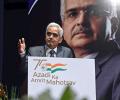
Reserve Bank Governor Shaktikanta Das on Thursday described cryptocurrencies as "clear danger" and said that anything that derives value based on make believe, without any underlying, is just speculation under a sophisticated name. The government is in the process of finalising a consultation paper on cryptocurrencies after gathering inputs from various stakeholders and institutions. Reserve Bank of India (RBI) has been flagging concerns about cryptocurrencies, which are seen as a highly speculative asset.

'Professors can teach even when they are 90 because they don't lose their skill with words. Go deeper and there's spirituality in it.'

In January, Visa's chief executive officer, Al Kelly, said during an earnings call that "there's been a burst of the balloon in valuations in the fintech world". Noting that the trend of lower valuations "is a helpful characteristic of the current environment", he added: "We will look for capabilities and management teams that will bring more value to Visa than we can bring ourselves." Data from KPMG's Pulse of Fintech H2'22 shows that global fintech investment - via mergers and acquisitions (M&As), private equity (PE) and venture capital (VC) firms - at $164.1 billion in 2022, was down 31 per cent over the year before. Indian fintechs held up better during this timeframe, attracting $6 billion, or a fall of 24 per cent.

From the US, Modi will travel to Egypt at the invitation of President Abdel Fattah El-Sisi.

Modi said this 'special invitation' from President Joseph Biden and First Lady Jill Biden for a state visit is a reflection of the vigour and vitality of the partnership between the democracies.

Modi and Albanese also reiterated their shared ambition for an early conclusion of the ambitious Comprehensive Economic Cooperation Agreement (CECA) that is expected to significantly expand bilateral trade ties.

'If you want it to grow well and serve the true needs of the economy, it needs a lot of freedom and flexibility, which comes in terms of the reform objective set by the regulator.'

Tiger Global-backed Koo, an Indian alternative to Twitter, has laid off 30 per cent of its workforce of 260 employees in the last year as the budding firm, like many other start-ups in the country, battles global headwinds. "It's important for businesses of all sizes to adopt efficient and conservative approaches to see this period through. "In line with this, we have acted on some role redundancies by letting go of 30 per cent of our workforce over the course of the year," said a Koo spokesperson.

'India has the potential to do a lot more to take advantage of the time today where we stand to gain, geopolitically and in terms of market attractiveness.'

The prime minister, who is visiting the US at the invitation of President Biden and First Lady Jill Biden, will join them for the state banquet along with a number of dignitaries on Thursday.

A rare 18th century decorated gun made in India for Mysore ruler Tipu Sultan, and valued at around GBP 2 million, has been barred from export to allow time for a UK-based institution to acquire it for the public study of a "fraught period" in India-UK history.

Supreme Court judge Justice DY Chandrachud has said that the decriminalisation of Section 377 of IPC by the apex court has enabled queer people to emerge as legally empowered citizens.
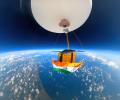
Lauding India's ambitious space programme, The New York Times has said the country, currently witnessing an 'explosive' growth in space-tech start-ups, is set to 'transform the planet's connection to the final frontier' and can emerge as a 'counterweight' to China.

US-based retail giant Walmart is looking to source toys, shoes and bicycles from Indian suppliers as the company is targeting to increase its exports from India to USD 10 billion annually by 2027. The company also wants to develop new suppliers in categories such as food, pharmaceuticals, consumables, health and wellness, and apparel and home textiles, a company spokesperson told PTI. Officials from the Bentonville-headquartered firm recently held a virtual meeting with several domestic toy manufacturers in India.

"Come and join my party," Israel's Prime Minister Naftali Bennett said, as the two leaders laughed and shook hands when they met on the sidelines of COP26 climate summit in Glasgow on Tuesday.

India is attempting to soft-land a rover on the moon and will attempt, at some point next year hopefully, sending humans into orbit. All of this makes an exciting time for space around the world, notes Aakar Patel.

From the seas to the stars, this partnership will now be deepened by the defining role of technology, the statement said.

J G Kulkarni, executive vice-president at Crompton Greaves and newly appointed president of the Indian Electrical & Electronics Manufacturers' Association speaks to Businsess Standard on the challenges and opportunities.

Anil Agarwal, chairman and managing director, Sterlite Industries speaks on his future plans.
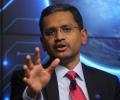
In March this year, when Tata Consultancy Services (TCS) unveiled a new brand statement of "Building on Belief", many wondered if it was the right strategy. When things are uncertain, wouldn't a brand statement such as "Experience Certainty" have been better? But for Rajesh Gopinathan, CEO & MD, TCS, it was all about the way the company was looking at business. As Gopinathan explained over a video call, "Today, we have over 1,000 customers and 98 per cent of our business is repeat business; our relevance to customers should continue, and to increase.

The new Surface Pro an impressive upgrade over its predecessors, says Aparna Banerjea.

Prime Minister Narendra Modi's call to make this decade a "techade" for India and the push for 5G, semiconductors and transformation through digital services is going to boost the technology sector in the country, industry players said on Monday. Modi, in his speech on the 76th Independence Day, touched upon all-round development of technology in the country, from 5G to push for electronic chips, laying of optical fibre cable (OFC) network across villages and enablement of digital entrepreneurship in villages through Common Services Centres, making the present decade as "techade" for India. Homegrown mobile devices maker Lava International's Chairman and Managing Director Hari Om Rai said electronics and technology sectors create about $4 trillion of revenue.
